Prostate cancer radiotherapy has changed fast this year, and the biggest news for UK patients is how much shorter treatment can now be.


At the ASTRO 2026 meeting in Boston, researchers presented new results on five-session stereotactic radiotherapy and shorter courses after surgery. In June, NHS England also announced a rollout of five-session treatment for early disease.
This guide looks at what was shown and which parts of it may help you now. It also covers what is still too early to be used. Conference results are preliminary until they are published and peer-reviewed. If you are newly diagnosed, our prostate cancer page is a useful place to start.
What ASTRO 2026 showed about prostate cancer radiotherapy
The American Society for Radiation Oncology (ASTRO) held its annual meeting in Boston from 26 to 30 September 2026. Two terms are useful to remember: stereotactic body radiotherapy (SBRT) and stereotactic ablative radiotherapy (SABR).
Stereotactic body radiotherapy (SBRT) gives a higher dose in each session, using tightly focused beams. That is why the course is shorter. The NHS calls it stereotactic ablative radiotherapy, or SABR. Our guide to five-fraction radiotherapy explains how it works.
Prostate cancer radiotherapy: the basics in two minutes
Prostate cancer radiotherapy, also called prostate radiation therapy, uses high-energy radiation to damage cancer cells so that they stop growing. Doctors use it in four main ways:
- as the main treatment for cancer that is still inside the prostate
- alongside hormone therapy for higher-risk disease
- after surgery, if the cancer returns or is likely to return
- to ease symptoms when cancer has spread.
Who can have prostate cancer radiotherapy?
Doctors group early prostate cancer by risk. They use your PSA (Prostate-Specific Antigen) level, the Gleason grade group from your biopsy, and the stage shown on scans. Most new SBRT evidence is in low- and intermediate-risk disease. Prostate cancer radiotherapy for higher-risk disease usually means a longer course plus hormone therapy. For a wider view, see our guide to treatment options for prostate cancer.
External beam radiotherapy and brachytherapy
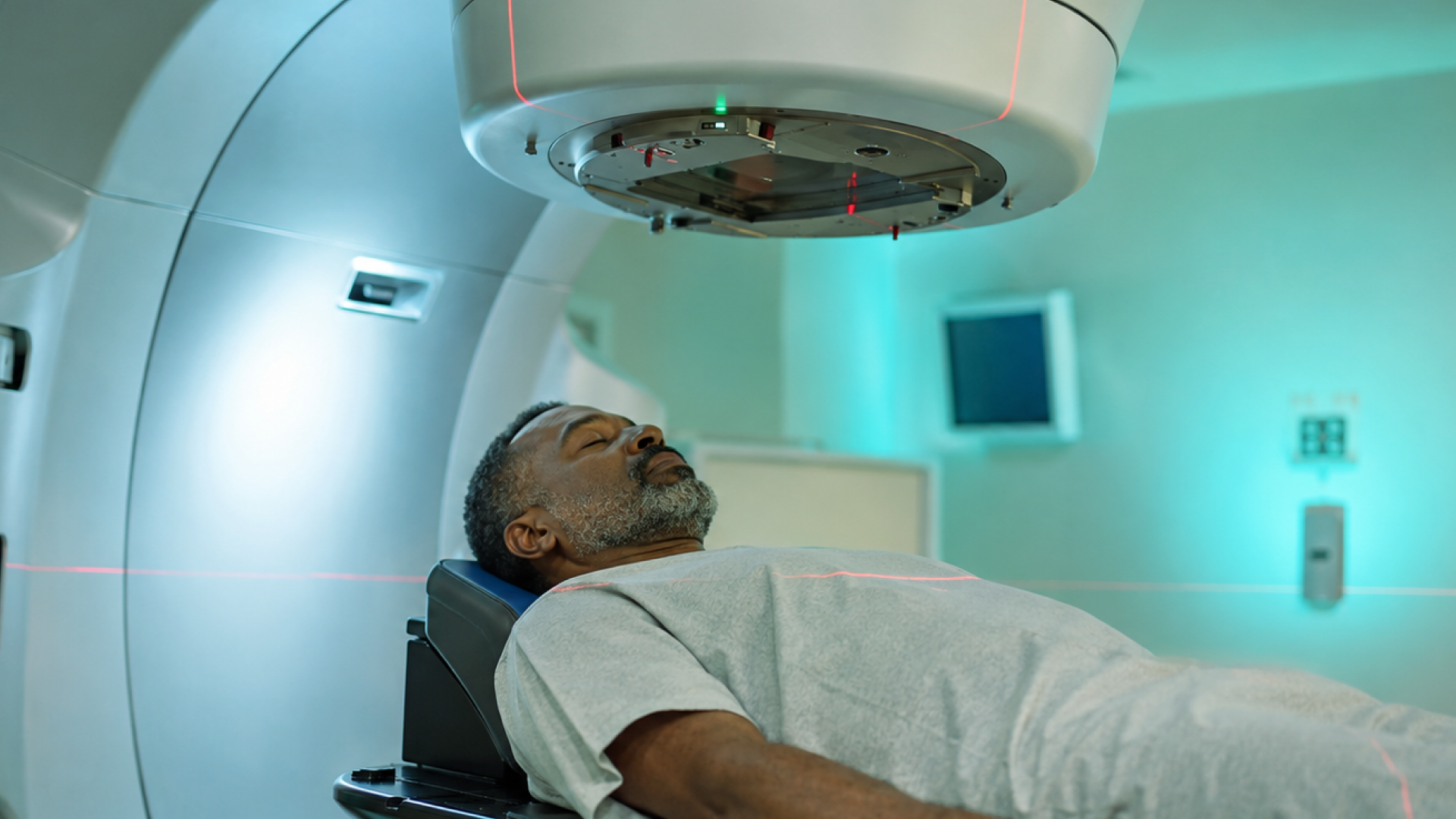
External beam radiotherapy is a beam of radiation from a machine placed outside the body. Some machines also scan with MRI during treatment. This is called MRI-guided radiotherapy.
Brachytherapy places radioactive sources inside or next to the prostate instead. Our comparison of five-fraction radiotherapy and brachytherapy goes into more detail.
Five sessions or surgery: what the PACE-A trial found
For many men with early disease, the key result from Boston was PACE-A’s long-term follow-up. Men choosing between surgery and prostate cancer radiotherapy have previously had little randomised evidence comparing the two.
Cancer control
PACE-A randomly assigned 123 men being treated at UK centres to either five-session SBRT or radical prostatectomy (prostate removal surgery). At a median follow-up of 8 years, 91% of men in the radiotherapy group had no sign of the cancer returning, compared with 84% after surgery. That gap was not statistically significant, so it could be down to chance. Only 13 cancer failures occurred across both groups.
Side effects and daily life
The biggest differences were in everyday function. In the first published results, half of the men who answered after surgery used one or more urinary pads a day at 2 years, compared with 6.5% after SBRT. Sexual function scores were higher after SBRT, while bowel scores were slightly worse. Not every man completed the questionnaires, so treat the figures as rough estimates.
What the trial cannot tell us
The trial was not designed to prove that radiotherapy and surgery give equal cancer control, and there were too few cancer events to show a true difference. Most men had low- or intermediate-risk disease, so the results do not apply to higher-risk cancer.
The researchers’ message was that men considering surgery should hear about SBRT before they decide. It does not mean radiotherapy beats surgery.
Talk through your options with Dr Perna
Choosing between surgery and radiotherapy depends on your cancer and on what matters to you. Dr Perna sees patients in person at five Surrey and London locations, and by e-consultation.
Five-session radiotherapy on the NHS: what has changed
In June 2026, NHS England announced that SABR, a form of stereotactic radiotherapy, is being offered for low- and intermediate-risk prostate cancer. All 48 radiotherapy providers in England are expected to offer it. Around 3,500 men a year are expected to choose five-session SABR instead of at least 20 sessions of more traditional treatment. Two points are worth keeping in mind:
- Your specialist team decides whether you are eligible, based on the features of your cancer.
- Services are starting at different times, so availability may differ between hospitals for a while.
The announcement only covers England. Scotland, Wales and Northern Ireland run their own health services. If you have been offered surgery or a longer course of prostate radiotherapy, it is fair to ask whether five-session SABR is an option, and why or why not.
Two sessions instead of five: the HERMES trial
HERMES was reported at the European radiotherapy meeting (ESTRO) in May 2026. In this trial, 46 men had either five sessions over 2 weeks or two sessions over 8 days on an MRI-guided machine. Around one in four in both groups had moderate urinary side effects. A trial this small cannot settle questions about long-term cancer control. Larger studies are needed before two sessions can be considered routine.
Radiotherapy after prostate surgery: a shorter course and a trade-off
Doctors offer prostate cancer radiotherapy after surgery when the PSA starts to rise, or when the results suggest a high chance of the cancer returning. The NRG-GU003 trial asked whether a shorter course could replace the standard one.
The trial compared 25 sessions with 37 sessions in 296 men, and at 2 years the shorter course did not cause excess urinary or bowel symptoms. The longer follow-up added a twist. At 5 years, serious side effects graded by doctors affected 16% of men on the shorter course and 7% on the standard course. Most were urinary problems. Cancer control was similar, and men’s own symptom reports showed no clear differences.
Doctor-graded effects capture events and treatment needed. Questionnaires capture how men feel day to day. For anyone with urinary problems after surgery, the extra risk is a real factor, and the weeks saved have to be weighed against it.
Hormone therapy and radiotherapy for prostate cancer
Hormone therapy lowers the hormones that feed prostate cancer. Hormone therapy and radiotherapy for prostate cancer are often combined in intermediate and higher-risk disease. Hormone therapy has side effects of its own. Your team will recommend whether and for how long, based on your risk group.
PSMA PET scans and rectal spacers
Two tools are changing how prostate cancer radiotherapy is planned. A PSMA PET scan uses a tracer that attaches to cancer cells. For people whose cancer has come back, a PSMA PET scan can detect PSA as low as 0.2 or 0.3 ng/mL. That can change where radiotherapy is aimed. A rectal spacer is a gel placed between the prostate and the rectum before treatment. It pushes the rectum away from the beam. If bowel side effects worry you, ask whether one is suitable.
If you would like to know about research you could be involved in, see our page on prostate cancer clinical trials.
Side effects of radiotherapy for prostate cancer
The side effects of radiotherapy for prostate cancer usually depend on the dose, the area treated, and the technique. Our guide to side effects of prostate cancer treatment explains them in detail. In short, early effects mostly involve the bladder and bowel. Urinary symptoms usually begin within 2 to 3 weeks of starting radiotherapy and go away within 3 months of finishing. What you eat can ease bowel symptoms, and we cover it in foods to avoid when having radiotherapy for prostate cancer.
Late effects of prostate radiotherapy can appear months or years later. Ask your team what to watch for.
Contact your radiotherapy team promptly if
Seek help quickly if any of these happen:
- You cannot pass urine, or you pass it only with great difficulty.
- You have heavy bleeding from the bladder or bowel, or blood clots in your urine.
- You have a fever or feel suddenly unwell during or after treatment.
- Pain is severe or is not controlled by the medicines you were given.
How to read conference results
Most new data are initially presented at conferences before full journal peer review. These checks can help you interpret the information:
- Look at how many men took part. Small trials can give wide margins of error.
- Look at how long patients were followed. Prostate cancer is slow, so a short follow-up period tells you less.
- Look at which patients took part. A result in low-risk disease may not apply to high-risk disease.
What to ask your clinical oncologist
These prompts can help turn the new evidence into a conversation about your own cancer. Take them to your appointment before starting prostate cancer radiotherapy:
- Ask what your risk group is and which treatments suit it.
- Ask whether five-session SABR is an option for you and, if not, why not.
- Ask how radiotherapy compares with surgery for your cancer. Ask about cancer control, and urinary, bowel and sexual function.
- Ask whether you will need hormone therapy, and for how long.
- Ask about your personal risk of side effects, and whether a rectal spacer could help.
- Ask whether there is a clinical trial you could join.
Private radiotherapy: options and choosing a centre
Some private hospitals and clinics in the UK offer prostate radiation therapy, and the techniques used can vary between them. Our guide to choosing a private prostate cancer specialist covers the wider picture. These checks are a useful starting point:
- Check who will treat you. Your plan should come from a clinical oncologist on the GMC specialist register.
- Ask which technique is proposed, why it suits your cancer and how often the team uses it.
- Ask for the plan in writing, and check with your insurer that your policy covers it before you book.
No centre can promise a particular result. A trustworthy provider will explain the evidence, including its limits, and will welcome a second opinion.
For everyone who has a prostate
Prostate cancer affects anyone who has a prostate, including trans women and non-binary people. Trial participants are generally described as men, so the evidence here says little about other groups. If this applies to you, talk to your team about how the options fit your situation.
Discuss your own results with Dr Perna
If you would like a specialist view on your scans, your PSA results or the options in front of you, Dr Perna can help. Read more about Dr Perna or get in touch to arrange an appointment.
Frequently asked questions
What is new in prostate cancer radiotherapy in 2026?
The main developments are the long-term PACE-A results and NHS England’s rollout of five-session SABR for low- and intermediate-risk disease.
Is radiotherapy as good as surgery for early prostate cancer?
In PACE-A, cancer control was similar after SBRT and surgery. The difference was not statistically significant. The trial was small and was not designed to prove the two are equal. The right choice depends on your cancer and your priorities, and you can read more in our guide to treatment options for prostate cancer.
Can I have five-session radiotherapy for prostate cancer on the NHS?
NHS England announced in June 2026 that five-session SABR is being rolled out for low- and intermediate-risk disease. Your specialist team decides whether you are suitable. Availability may vary while services start, and the announcement covers England only.
Does shorter radiotherapy cause more side effects?
Not always, but it can. After prostate surgery, a shorter course caused more serious urinary side effects in the NRG-GU003 trial at 5 years. Ask your team about your own risks, and see our page on side effects of prostate cancer treatment.
Will I need hormone therapy with radiotherapy?
Hormone therapy is often given with radiotherapy for intermediate and higher-risk disease. Your team will recommend whether you need it and for how long. You can find more on hormone therapy here.
Can I have prostate radiotherapy privately in the UK?
Yes. Some private hospitals and clinics in the UK offer prostate cancer radiotherapy, though the techniques differ between centres. Ask who will treat you, which technique is proposed and why, and whether your insurer covers it. Our guide to external beam radiotherapy explains what the main treatment involves.