CyberKnife, MR-Linac, gantry linac or TomoTherapy. Dr Carla Perna explains what each of the five-fraction radiotherapy machines does and what it means for you.

Key takeaways
- Five-fraction radiotherapy machines fall into five groups: gantry linear accelerators, robotic systems, MR-guided linacs, helical systems, and dedicated proton and radiosurgery platforms.
- Each group solves the same two problems differently: finding the target on the day, and allowing for it to move.
- PACE-B used both robotic and conventional platforms and reported results for the trial as a whole.
- Prostate treatment relies on gold marker tracking and daily imaging.
- Five sessions in total. Session length varies from around 10 minutes to an hour.
You have been given a machine name. Here is what it means
Five-fraction radiotherapy machines have names that mean very little on the day you first hear one. A consultant mentions five fractions, says a word like CyberKnife, TrueBeam, Unity or Halcyon, and the appointment moves on. By the evening, you are searching that word, and what comes back is either a manufacturer’s website or a physics paper you cannot open.
This page explains what each of the five-fraction radiotherapy machines does during a course of five-fraction radiotherapy, what the session feels like from the couch, and how much the equipment really affects your treatment. It promotes no single system.
In my clinics across Surrey and London, the machine question usually comes second. The first is whether five sessions can do the work of thirty. Stereotactic radiotherapy answers that one, and the evidence behind it is strong. The second deserves a proper answer too, because the equipment does shape how treatment is planned and delivered. It shapes it far less than the internet suggests.
What five fractions means, and why the equipment carries more weight now
A fraction is a single radiotherapy session. Conventional external beam radiotherapy splits the total dose into many small fractions, historically 20 to 39 over several weeks. A five-fraction course delivers a comparable biological effect in five much larger doses. You will see it referred to as ultra-hypofractionation or SABR when the target is small, and the margins are tight.
This works because tissues respond differently to the size of each dose. Prostate cancer cells are unusually sensitive to higher individual doses, more so than much of the surrounding healthy tissue.
Here is where the machine comes in. Across 20 sessions, a small daily inaccuracy tends to average itself out, while with five sessions, there is no averaging. Each session carries roughly a fifth of the whole treatment. So the equipment has to find the target precisely on the day, then hold that accuracy while the dose goes in.
The five-fraction radiotherapy machines used across the UK
Five groups of equipment deliver this treatment here and they differ in how they see you, how they move around you, and how long you spend on the couch.
MR-guided linacs (Elekta Unity, MRIdian)
These combine an MRI scanner with a linear accelerator, so soft tissue can be seen live. Conventional image guidance shows bone and markers clearly but the prostate, bladder and rectum poorly. MRI-guided treatment shows the organ itself, so the plan can be adapted at each session and the beam held if the target drifts.
This is the group I reach for in harder situations rather than as a default: prostate treatment where the rectum sits very close, re-radiation of an area already treated, and selected renal tumours. Sessions are long, often 30 to 60 minutes, and UK centres are few. For many targets, a modern gantry linac does everything the plan requires. There is a fuller comparison of MRI-guided and standard radiotherapy if you want the detail.
Gantry linear accelerators (TrueBeam, Versa HD, Halcyon, Ethos)
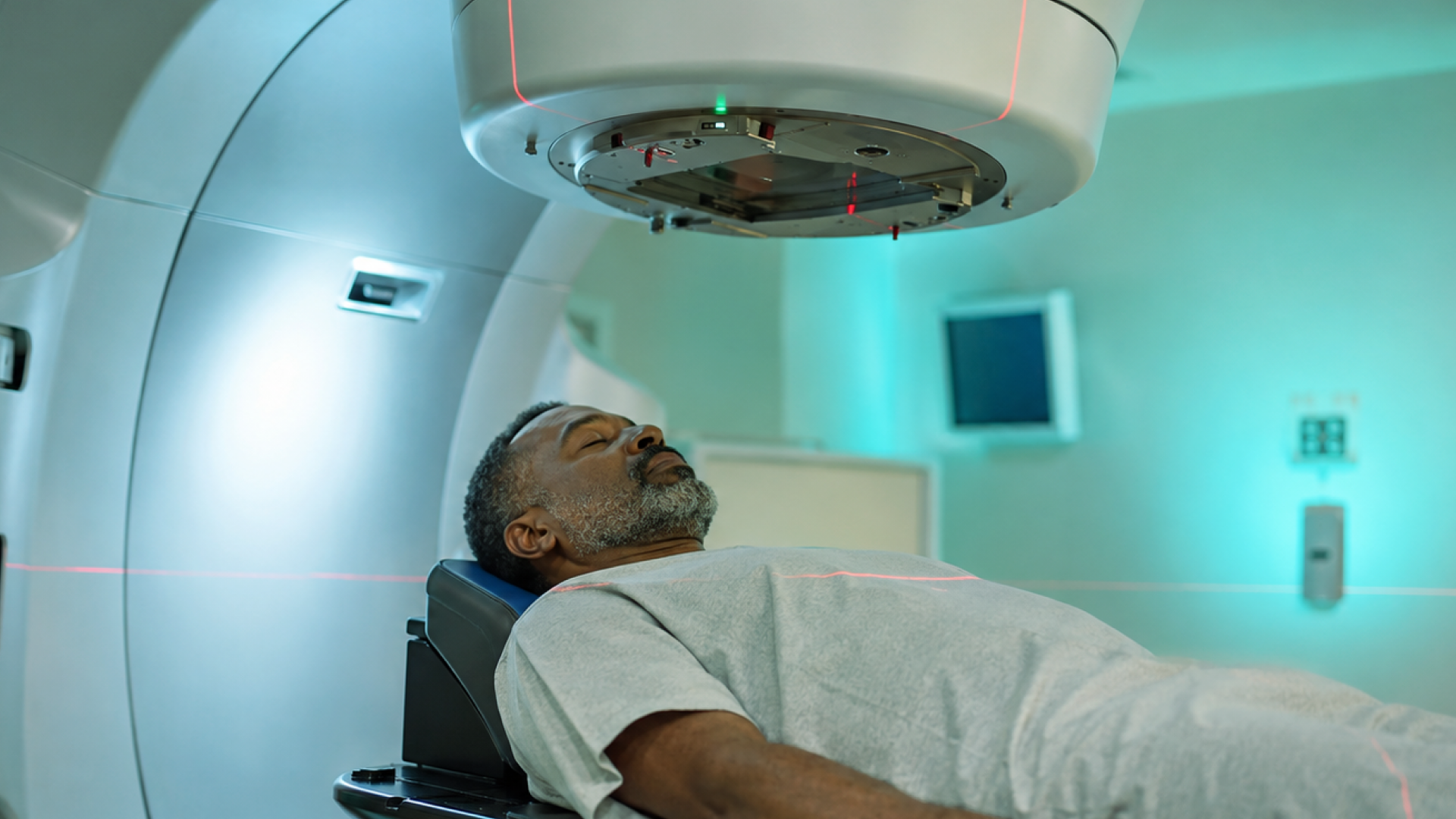
This is the workhorse of UK radiotherapy, and the machine most five-fraction treatments are given on. A large arm rotates around you while you lie still. Moving metal leaves shape the beam to the target as the gantry turns, usually across one or two arcs, and the beam-on time is short.
Before each session, the machine takes a cone-beam CT scan and compares it with your plan, so your position can be corrected before anything switches on. Ethos systems can also adjust the plan to the anatomy seen that day. Halcyon is a faster, enclosed design that looks more like a CT scanner.
Robotic systems (CyberKnife)
A compact accelerator sits on a robotic arm and fires many small beams from a wide range of angles rather than sweeping through an arc. Paired X-ray cameras check your position repeatedly during the session, and the robot corrects for movement as it happens. That is why these systems are described as tracking rather than aiming. The trade-off is time, since the dose builds up from many small beams.
Proton beam therapy, Gamma Knife and ZAP-X
Proton therapy uses charged particles that stop at a set depth rather than passing through the body. The UK has two NHS high-energy proton centres: The Christie in Manchester, which opened in December 2018, and University College London Hospitals, which opened in December 2021. Their established use is in specific tumours, particularly in children and young adults, rather than routine prostate treatment. Gamma Knife and ZAP-X treat the brain only.
What every machine has to get right
The differences above count for less than what follows. Whatever the platform, a safe course depends on the same steps being done well.
The groundwork before your first session
It starts with a planning scan, usually a CT taken in the exact position you will lie in each day, often with an MRI merged onto it so the target edges can be drawn confidently. For prostate treatment, three small gold markers are often placed in the prostate first, giving the machine something sharply visible to lock onto. A hydrogel spacer may also be inserted between the prostate and the rectum to push the two apart. None of this is optional detail, because the margin drawn around the target depends partly on how confident the team can be about position.
How five-fraction radiotherapy machines handle movement
The prostate shifts with bladder and bowel filling, which is why you will be given clear instructions about what to drink beforehand. Targets in the chest and upper abdomen move with every breath, so treatment there may be timed to one phase of your breathing.
Machines deal with this in three broad ways, and most centres use more than one at a time:
- Tracking, where imaging follows the target and the beam is corrected as it moves.
- Gating, where the beam only fires within a set window, such as a phase of your breathing.
- Surface monitoring, where cameras watch your body and pause the beam if you shift.
Whether the platform changes your outcome
This is the question sitting behind most searches.PACE-B, the trial that established five-fraction SABR for localised prostate cancer, allowed both robotic and conventional linac platforms and reported results for the trial as a whole. A later analysis found the two were not identical on paper. Around 41% of the men who received SABR in PACE-B were treated on a robotic system, and their plans carried a higher peak dose to the urethra, 45.9 Gy compared with 42.8 Gy, because robotic planning tends to be more heterogeneous. Both stayed within the safety limits set for surrounding organs.
So the plans differ, and the long-term significance of that is still being studied. What the evidence does support, however, is that whilst one platform may not deliver better cancer control than another, the platform can matter when it comes to side effects.
The MIRAGE trial provides clearer insight into this distinction. This phase III randomised trial directly compared five-fraction MR Linac treatment (with 2mm margins) against conventional linac radiotherapy (with 4mm margins). The results showed that patients treated with MR Linac experienced significantly fewer side effects, with acute grade 2 or worse genitourinary toxicity occurring in 14% of the MR Linac group compared with 29% of the conventional linac group. Gastrointestinal side effects also favoured MR guidance. Two-year follow-up data found similar benefits with late side effects.
What this means in practice is straightforward. Cancer control outcomes are comparable between platforms when delivered by experienced teams. The real difference lies in how each platform affects day-to-day life after treatment. The tighter margins possible with MR imaging mean less radiation exposure to healthy tissue, which translates to fewer bladder and bowel symptoms for many men.
Among the five-fraction radiotherapy machines in the UK, the planning precision, the daily imaging and the expertise of the team running the treatment carry more weight than the badge on the front. That said, the evidence suggests that if side effect reduction matters to you, and for most patients it does, MR Linac technology offers a measurable advantage.
Talk through the platform your treatment would use
Dr Carla Perna offers stereotactic radiotherapy and MRI-guided treatment for prostate, renal and oligometastatic disease across clinics in Surrey and London, including re-radiation cases where earlier treatment limits the options. She will explain which platform suits your target and what the alternative would mean.
Prostate treatment: what five fractions asks of the equipment
The evidence behind five-fraction prostate treatment sets its own demands on the equipment, and most of them show up well before the first beam switches on.
For localised prostate cancer, the priorities are markers, spacers, bladder and bowel preparation, and tighter margins. Sessions are usually spread over one to two weeks, often on alternate days, which is thought to help healthy tissue recover. With around 57,900 new prostate cancer cases every year in the UK, this is now a common reason men here will be offered five fractions. The same approach is used for lung tumours, bone secondaries and some oligometastatic sites, and it sits alongside options such as brachytherapy.
What five-fraction radiotherapy machines mean for your appointments
The technical detail can obscure the practical side, so here is what changes for you.
Time on the couch and time in the department
The number of visits is the same wherever you go: five. The length of each visit is not. Allow roughly 10 to 20 minutes on the couch for a gantry linac, longer for a robotic system, and up to an hour on an MR-guided linac. Preparation and imaging add to that. Five-fraction radiotherapy machines differ far more in appointment length than in trips made, so ask for a door-to-door estimate rather than the beam-on time.
Side effects follow the treated area
Side effects track the part of the body being treated far more closely than the platform delivering the dose. After prostate treatment, passing urine more often, urgency, looser bowels and tiredness are common early on and usually settle. You can read more on prostate cancer treatment and side effects if that is your area.
When a longer schedule is the safer choice
Five fractions is not right for everyone. Larger tumours, targets close to the bowel or spinal cord, some previous radiotherapy and certain connective tissue conditions can all make a longer course safer. If your team recommends more sessions, that is a clinical judgement about your anatomy and your disease, not a lesser standard of care.
Trans women, non-binary people and anyone assigned male at birth who has not had a prostatectomy still has a prostate, and everything here applies equally. Hormone therapy affects both the tissue and the imaging, so tell your team about any gender-affirming treatment.
Access across the UK, and what to ask before you agree
Gantry linear accelerators are available at every NHS radiotherapy centre, and five-fraction prostate SABR is an established NHS treatment. Robotic, MR-guided and helical systems sit in fewer centres, so access can depend on where you live as much as on what you need.
Questions worth asking your oncologist
- Which machine will my treatment be given on, and why that one for my case
- How you will check my position each day, and whether the plan can be adjusted
- Whether I will need markers, a spacer or breath-hold, and what each involves
- How long each session will take from arriving to leaving
- Whether a different schedule or platform would suit me better
Get a clear answer about your own treatment
If you have been offered five-fraction radiotherapy, or you want a second opinion on the plan you have been given, Dr Carla Perna sees patients at Nuffield Health Guildford, GenesisCare Surrey, Cromwell Hospital, London Bridge Hospital and Nuffield Health Parkside. She reviews prostate cancer and oligometastatic disease cases, and is active in clinical research in this area.
Frequently Asked Questions
Are some five-fraction radiotherapy machines better than others?
Not in any general sense. Robotic and conventional linac platforms were both used within PACE-B, and results were reported for the trial as a whole rather than by platform. The two produce somewhat different dose distributions, and both are recognised ways of delivering this treatment. The planning, the daily imaging and the experience of the team have more bearing on your care than the machine type.
Do I need an MR-Linac for five-fraction radiotherapy?
MR-guided treatment allows soft tissue to be seen live and the plan adapted at each session. That is valuable in selected cases, such as re-radiation or targets sitting very close to the rectum. Most five-fraction courses in the UK are delivered safely on standard gantry linear accelerators with cone-beam CT imaging. Availability is limited, so ask your oncologist whether it would make a meaningful difference for your specific target.
How long does each five-fraction radiotherapy session take?
Roughly 10 to 20 minutes on the couch for a modern gantry linac, longer for a robotic system, and up to an hour on an MR-guided linac. Positioning, imaging and preparation add to that, so plan for a longer appointment than the treatment time alone suggests.
Are the five sessions given on consecutive days?
Not always. It depends on what is being treated. Prostate SABR is more often spread over one to two weeks, frequently on alternate days, because the gap is thought to help healthy tissue recover between the larger doses.
Why are gold markers or a spacer used before prostate treatment?
Fiducial markers are tiny gold seeds placed in the prostate. They show clearly on imaging, which gives the machine a precise target to align to and track. A hydrogel spacer is a gel inserted between the prostate and the rectum to push them apart and reduce the dose reaching the bowel wall. Not everyone needs both, and practice varies between centres and platforms.
Is five-fraction radiotherapy available on the NHS?
Yes, five-fraction SABR for suitable localised prostate cancer is delivered within the NHS. Access to specific platforms such as MR-guided or robotic systems is more limited and depends on your local centre.